




Year: Completed in 1924 Description: This basilica was built on the site of a former Byzantine and Crusader church to commemorate the transfiguration of Jesus. It adopts a Roman-Syrian architectural style, featuring twin towers and an underground…


After the birth of Jesus, and at the time of the purification of Mary, the Child was presented in the Temple.
Lk 2:22-38

Our Lady and St. Joseph had been to Jerusalem on pilgrimage ever since they were children, and so they already knew the Temple when the days were completed for their purification according to the law of Moses and they took Jesus there to present him to the Lord.9 It took
several hours, on foot or riding on a donkey, to cover the ten kilometers between Bethlehem and the Holy City. Perhaps they were
impatient to fulfill a law whose real meaning few could have suspected: “the Presentation of Jesus in the Temple shows him as the
First-born Son who belongs to the Lord.” 1 In order to commemorate
the people’s liberation from Egypt, the Law of Moses decreed
that every first-born male was consecrated to God;2 their parents
had to redeem them with an offering consisting of a sum of silver
equivalent to twenty days’ pay. The Law also laid down the purification of mothers after giving birth;3 Mary Immaculate, ever-Virgin, chose to submit to this precept without protest, although in
fact she was not bound by it.
Lk 2:22.
1. Catechism of the Catholic Church, no. 529.
2. Cf. Ex 13:1–2 and 11–16.
3. Cf. Lev 12:2–8.


Tradition tells us that the baptism of Jesus took place nine kilometers north of the Dead Sea, on the eastern bank of the Jordan River, near the road from Mount Nebo to Jericho.
Lk 3:1–22
Mk 1:9–11.
The traditions of the place were conserved until the fourteenth
century, at which point the area became insecure, pilgrimages became less frequent, and the memory of the location of Bethany on the other side of the Jordan was lost. It was recovered in 1897, thanks to the discovery of the Madaba map in Jordan. This map is a 6th century mosaic of the Middle East, names included: on both sides of the Jordan, very close to the Dead Sea, the names of “Bethabara, the place of St. John’s baptizing to the east of the river” and “Aenon, which is now Sapsaphas” are perfectly legible.
The markings of the Madaba map guided the first explorations
in 1899, followed by several others at the beginning of the 20th century. They were not continued, and then the political situation prevented further action for decades, until the 1994 peace agreements between Israel and Jordan. Then, the Franciscans of Mount Nebo urged the Jordanian authorities to start paying attention to Bethabara, and excavations began which uncovered Christian ruins.

In Cana, a small town near Nazareth, the Lord performed his first miracle, turning water into wine at Our Lady’s request.
Jn 4:46–54
Kefer Kenna is six kilometers from Nazareth, on the road leading down to Tiberias. The settlement, supplied by a spring of water, dates from at least two centuries before Christ. It seems that in the sixteenth century its inhabitants — most of them Muslims — still preserved the tradition that this was where Jesus had worked his first miracle. Pilgrims found there an underground room, reached from the ruins of a church that had once stood above it which had reputedly been built by the Emperor Constantine and his mother St. Helena. In 1641 some Franciscans settled in the village and opened negotiations aimed at the recovery of the ruins; this was not achieved until 1879. In 1880 a small church was built, and it was afterwards enlarged between 1897 and 1906. Additionally, in 1885
a chapel was built about a hundred meters away in honour of St. Bartholomew — Nathanael — who was a native of Cana.7
The shrine was restructured for the Jubilee of the year 2000, and before this was undertaken, archaeological research was carried out, completing the work of a previous dig in 1969. The excavations brought to light a mediaeval church and what might be a synagogue from the third or fourth century, built over the ruins of earlier dwelling- places dating from the first century. This synagogue had a courtyard with a mosaic pavement, and a portico with a large pool in the center, which forms the crypt of the current church; the columns and
capitals of the portico were also re-used for the nave. In the northern apse a still older apse was discovered, containing a tomb from the fifth or sixth century. The type of tomb seems to indicate a Christian presence in the Byzantine era.


Jesus's ministry in Galilee was marked by teaching, preaching the Gospel of the Kingdom, and healing all manner of sickness and disease. Those activities included: preaching in synagogues, starting his ministry inCapernaum, and calling his first disciples, who were fishermen.
Mt 4:12–17
Peter’s house According to ancient traditions, at the end of the first century there was a small community of believers at Capernaum. Jewish sources called them minim, “heretics,” because they had abandoned orthodox Judaism to adhere to Christianity.
They must have preserved the memory of Peter’s house, which with the passage of time became a place of worship. At the end of the fourth century, the pilgrim Egeria or Aetheria wrote, “In Capernaum the house of the Prince of the Apostles has been made into a church, whose walls are the same now as they were then. That is where the Lord cured the paralytic. Here too is the synagogue where the Lord cured a man possessed by a devil. The way in is up many stairs, and it is made of dressed stone.” A second witness, dating from a century later, states: “We came to Capernaum, to the house of Blessed Peter, which is now a basilica.”


In Jerusalem, you can find the remains of the Pool of Bethesda, where Jesus cured the paralytic. In the same area stands the church of St. Anne, venerated as the site of the Nativity of the Virgin.
Jn 5:2–3.
Jn 5:4 [Vg].
Jn 5:5–9.
The Gospels tell of many healings that Jesus performed, but only St. John recounts the healing of the paralytic who was af flicted by loneliness, whom no one remembered. In his narrative, after clarifying that Jesus had gone up to Jerusalem from Galilee to celebrate a Jewish feast, St. John describes in detail where the event took place: Now there is in Jerusalem at the Sheep Gate a pool called in Hebrew Bethesda, with five porticoes.
 The tradition about Mary’s birthplace comes from theProtoevangelium of James(2nd century), which says her parents, St. Joachim and St. Anne, lived in Jerusalem near thePool of Bethesda. There is no direct archaeological evidence, except for a 5th-century church dedicated to Our Lady, calledSt. Mary in Probatica, shown on the Madaba map (6th century). This basilica was destroyed and rebuilt several times, and by the time the Crusaders arrived in 1099, only ruins remained. They first built a small chapel and later, between 1130 and 1150, a large Romanesque church over a grotto venerated as Mary’s birthplace. This is today’sChurch of St. Anne, located in the Muslim Quarter of Jerusalem’s Old City, near the start of theVia Dolorosaand theLions’ Gate.

Tradition indicates that our Lord may have been transfigured on Mount Tabor, in the middle of the plain of Esdraelon.
1. Cf. Judges 4:4–24.
2. Cf. Judges 8:18–19.
3. Cf. Joshua 19:10–34.
4. Cf. Deut 33:19.
5. Cf. Hos 5:1.
6. Cf. Ps 89[88]:13.
7. Cf. Jer 46:18–26.
8. Lk 9:28–33. Cf. Mt 17:1–4; Mk 9:2–5.
9. Mt 17:5. Cf. Mk 9:7; and Lk 9:34–35.
According to the Old Testament it was at Mount Tabor that Deborah gathered ten thousand Israelites in secret, commanded by Barak, who put Sisera’s army to flight.1 The Midianites and Amalekites killed Gideon’s brothers there.2 After the Promised Land had been won, Mount Tabor marked the boundary between the tribes of Zebulon, Issachar and Nephthali,3 who held it to be a sacred place and offered sacrifices on its summit.4 The prophet Hosea denounced this worship because it was not just schismatic but actually idolatrous.5 Finally, the fame of Tabor is shown by the fact that it is used as an image in Old Testament literature. The psalmist speaks of Tabor and Hermon together as symbolizing all the hills of the earth.6 Jeremiah compares Tabor to the way Nebuchadnezzar loomed over his enemies.7
Archaeological excavations at Tabor have shown that there was
a fourth- or fifth-century church there (which some ancient sources
say was built by St. Helena) which had been constructed on the
remains of a Canaanite place of worship. Later on, the testimo
nies of some sixth- and seventh-century pilgrims speak of three
basilicas — in memory of the three booths that St. Peter had pro
posed to make — and large numbers of monks living there. In con
firmation of these reports, a mosaic floor has been found dating
from that time, and in 553 the Council of Constantinople estab
lished a bishopric of Tabor.
1. Cf. Judges 4:4–24.
2. Cf. Judges 8:18–19.
3. Cf. Joshua 19:10–34.
4. Cf. Deut 33:19.
5. Cf. Hos 5:1.
6. Cf. Ps 89[88]:13.
7. Cf. Jer 46:18–26


When Jesus went to Jerusalem, he often stayed at the home of Martha, Mary and Lazarus in Bethany. Today pilgrims can visit the tomb of Lazarus, where he was buried before Our Lord raised him from the dead.
1. Lk 10, 38–42.
2. Mk 14:9; cf. Mt 26:13.
3 Jn 11:2–6.
4. Jn 11:17–30.
On the eastern side, on the remains of the Byzantine basilicas, the Custody built the present church in 1954. It takes the form of a mausoleum, with its outline in the shape of a Greek cross, and an octagonal cupola surmounted by a dome. Each of the arms of the cross is adorned with a rounded mosaic, representing the most significant Gospel scenes connected with Bethany: the dialogue between Martha and Jesus; the two sisters receiving him after the death of Lazarus; the raising of Lazarus; and the dinner in the house of Simon. The construction of the church produces a striking contrast between the semi-darkness of the church and the light that floods the cupola, symbolizing death and hope of resurrection.


On the western side of the Mount of Olives, theDominus Flevitchurch recalls the tears Christ shed for Jerusalem upon his triumphal entry into the city, a few days before his Passion.
1. Lk 19:41–44.
2. Mt 23:37–39; cf. Lk 13:34–35.
The roof of the Dominus Flevit church is meant to represent a tear. A large window in the apse looks out over the Old City of Jerusalem, from which the Dome of the Rock, the cupola of the Holy Sepulchre, and the tower of the Franciscan convent of St. Savior — the seat of the Custody of the Holy Land — are all visible.


According to ancient tradition, the room of the Last Supper is located in a southwestern corner of the Old City, on a hill which has been called Zion since the Christian era.
1. Jn 13:1.
2. Mk 14:12.
3. Mk 14:13–15.
4. Cf. Jn 20, 19–29.
5. Jn 20, 28.
6. Acts 1:13–14.
The room of the Cenacle retains its Gothic architecture which was
restored in the 14th century. The
construction along the wall on the left and the small dome above the stairs are from the Muslim era.


Tradition places the garden of Gethsemane on the Mount of Olives, across the Kidron Valley.
1.Lk 22:44-46
2.Lk 22:39.
3. Jn 18:1.
4. Mt 26:36; Mk 14:32.
5. Jn 18:2.
6. Mk 14:32–36.
7. Mk 14:41–43.
The rock where, according to tradition, our Lord lay prostrate in prayer, in the center of the Basilica of the Agony. The central apse depicts the Agony in the Garden.
The Basilica of Agony is also called the Church of All Nations because the cost of its construction was taken on by 16 countries. On the right, the mosaics of the cupolas suggest a starry sky seen through the branches of the trees. The eight most ancient olive trees of Gethsemane may date back to the first millennium.


Not far from the Cenacle stands the Church of St. Peter in Gallicantu, over the spot which some traditions say to be the house of the high priest, Caiphas.
The band of soldiers and their captain and the officers of the Jews seized Jesus and bound him. First they led him to Annas; for he was the father-in-law of Caiaphas, who was high priest that year. It was Caiaphas who had given counsel to the Jews that it was expedient that one man should die for the people.(Jn 18:12–14.)
All four Evangelists describe the interrogation of Jesus by the chief priests and the Sanhedrin. It took place in the house of Caiaphas. (Cf. Mt 26:57.) Two exceptional witnesses managed to get as far as this point, for Simon Peter and another disciple followed Jesus there. This other disciple was known to the High Priest and went into the court with Jesus. Peter, however, stayed outside at the door. Then the other disciple went out and spoke to the maid who kept the door and brought Peter in. (Jn 18:15–16).
During the trial there was a strong contrast between the behaviour
of Jesus and Peter. Confronted with unjust accusations, unfounded
charges, false witness and insults, Jesus kept silent. Then,
when the time came for him to proclaim the truth, he spoke calmly.
Peter, terrified by the servants, denied having anything to do with
Jesus. I do not know him; (Lk 22:58.) I do not know what you are saying; (Mt 26:70)
I do not know this man. (Mk 14:71.)
And immediately, while he was still speaking, a cock crowed.
The Lord turned and looked at Peter. And Peter remembered the
word of the Lord, how he had said to him, “Before the cock crows today, you will deny me three times.” And he went out and wept
bitterly. (Lk 22:60–62.)
1. Jn 18:12–14.
2. Cf. Mt 26:57.
3. Jn 18:15–16.
4. Lk 22:58.
5. Mt 26:70.
6. Mk 14:71.
7. Lk 22:60–62.
8. Lk 22:60–62.
The part of Jerusalem where this episode took place was on the
eastern slope of Mount Zion, not far from the Cenacle (the room of
the Last Supper). In the time of Jesus this was a residential district,
looking over the Kidron and Hinnom valleys. Scholars offer two
or more possible locations for the house of Caiaphas within this
district, but archaeological excavations incline slightly in favour of
the Church of St. Peter in Gallicantu. This church stands on a site which has belonged to the Augustinians of the Assumption since the nineteenth century. Excavations carried out from 1888 to 1909 and from 1992 to 2002 brought to light the remains of a house dating to the Herodian era with mills, cisterns and cellars. A further find was a finely-carved stone lintel, with an inscription indicating where to deposit sin-offerings, and collections of weights and measures as used in the Temple. This house had later been venerated by Christians, who built a church over it in the fifth century; some pieces of mosaic flooring still survive. The center of the basilica was a deep cistern, which must originally have been a ritual Jewish bath.
Outside the church of St. Peter in Gallicantu, a sculpture recreates the denial of the prince of the apostles.
In the upper chapel, the altarpiece portrays the high priest’s interrogation of our Lord. Above, the intermediate oratory dedicated to St. Peter; from left to right: his denial, bitter tears, and finally, Christ’s confirmation of his primacy.
To the right, the cistern revered as the deep pit where Jesus would have awaited the dawn of Good Friday. It has a double door which indicates it was previously used for ablutions of the Jews. In the vault there is a hole in which three crosses had been engraved during the Byzantine era, and on the walls, the remains of several painted crosses were found.
Next to the church, a street runs along the hillside. Jesus could
have walked on this road on the night of Holy Thursday.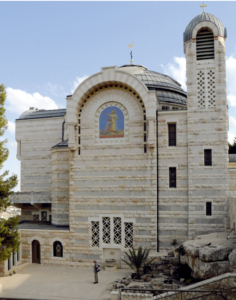


The fourteen Stations of the Cross commemorate the Carrying of the Cross from the praetorium to Calvary, the Crucifixion, and the interment of our Lord’s body in the Sepulchre.
Pontius Pilate condemns Jesus to death.
Jesus willingly accepts and patiently bears his cross.
Weakened by torments and by loss of blood, Jesus falls beneath his cross.
Jesus meets his mother, Mary, who is filled with grief.
Soldiers force Simon of Cyrene to carry the cross.
Veronica steps through the crowd to wipe the face of Jesus.
Jesus falls beneath the weight of the cross a second time.
Jesus tells the women to weep not for him but for themselves and for their children.
Weakened almost to the point of death, Jesus falls a third time.

On Good Friday, the Christian faithful of Jerusalem — mostly Arab Christians — carry a wooden cross in a procession along the Via Dolorosa.
Do you want to accompany Jesus closely, very closely?...
Open the Holy Gospel and read the Passion of Our Lord. But don’t just read it: live it. There is a big difference. To read is to recall something that happened in the past; to live is to find oneself present at an event that is happening here and now, to be someone taking part in those scenes.1 Down through the centuries, that is how the saints, and many thousands of Christians with them, have contemplated the redemptive death of Jesus on the Cross and his Resurrection: the Paschal mystery, which is at the heart of our faith.(Catechism of the Catholic Church, no. 571.)With the passage of time the faithful’s meditation on those events has developed into various devotional practices, foremost among which is the Stations of the Cross.
The purpose of following the Stations of the Cross is to contemplate, with a spirit of contrition and compassion, the last and most painful part of our Lord’s sufferings, accompanying him spiritually along the path he trod, carrying the Cross, from the praetorium to Calvary, and there, from his nailing to the Cross until his burial.
1. Jn 19:17.
Places of each station:


The last five Stations of the Cross are located inside the Basilica of the Holy Sepulchre.
The Gospels tell us that Jesus wastaken out and led to the place called Golgotha, which means “the place of the Skull.” (Mk 15:22. Cf. Mt 27:33; Lk 23:33; and Jn 19:17.) There they crucified him, and with him two others, one on either side, and Jesus between them. (Jn 19:18). This place was near the city, (Jn 19:20) in other words, outside the city walls. In the place where he was crucified there was a garden, and in the garden a new tomb where no one had ever been laid.(Jn 19:41) When Christ died, as it was the Jewish day of Preparation, and the tomb was close at hand, they laid Jesus there. (Jn 19:42).
The soldiers strip Jesus of his garments, treating him as a common criminal.

On entering the Basilica of the Holy Sepulchre, two very steep stone steps immediately on the right lead up to the chapels of Golgotha, the place of execution. These are about five metres above the ground level of the basilica.
On arriving at this point pilgrims usually pause to contemplatethe Tenth Station.
Jesus’ hands and feet are nailed to the cross. Only a few steps separate the Tenth Station and the Eleventh, which is commemorated by an altar surmounted by a mosaic showing the Crucifixion. The chapel belongs to the Franciscans of the Custody of the Holy Land.

After suffering greatly on the cross, Jesus bows his head and dies.
To the left of the Chapel of the Crucifixion is the Chapel of Calvary, which belongs to the Greek Orthodox Church. It is constructed on the venerated rock which may be seen through a glass covering. Below, a circular piece of silver surrounds the hole in which the cross was set.
In the part of the visible rock on the right, one can see a fissur attributed to the earthquake that occurred upon Christ’s death: But Jesus cried out again in a loud voice, and gave up his spirit. And behold, the veil of the sanctuary was torn in two from top to bot tom. The earth quaked, rocks were split.(Mt 27:50–51.) The cleft in the rock is also visible in a chapel directly below, dedicated to Adam. According to a pious tradition which Origen references in the 3rd century, there lay the tomb of the first man; as the earth opened up, the blood of Our Lord made its way to his remains, making him the first redeemed man. This legend inspired the custom of putting a skull at the foot of the Cross in Christian iconography.


The lifeless body of Jesus is tenderly placed in the arms of Mary, his mother.

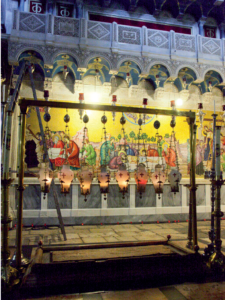
This scene is commemorated between the Chapel of the Crucifixion and the Chapel of Calvary, at an altar dedicated to Our Lady of Sorrows.
14. Jesus is laid in the Tomb
Coming down from Calvary and returning to the atrium of the basilica, we find the Stone of Unction, which is especially venerated by Orthodox Christians. It is a reddish stone with white streaks running through it, and it commemorates the care given to the Body of Jesus by Joseph of Arimathea and Nicodemus.


1. Mk 15:22. Cf. Mt 27:33; Lk 23:33; and Jn 19:17.
2. Jn 19:18.
3. Jn 19:20.
4. Jn 19:41.
5. Jn 19:42.
The Ninth Station of the Via Dolorosa left us very close to Calvary. So far we have been following Jesus as he carries his Cross, along the route traced out by tradition and popular Christian piety. Now we come to the actual place that is at the center of our faith, and that we can consider as the most sacred spot in the Holy Land: the place where Jesus “was crucified, died and was buried,”
and where “on the third day he rose again from the dead.” (Apostles’ Creed).
The whole zone is now included within the Basilica of the Holy Sepulchre, also known to Orthodox Christians as the Basilica of the Resurrection. To the pilgrim’s eyes its architecture seems remarkable, even chaotic. The interior of the basilica is a complex of altars and chapels, big and small, walled and open, set at different levels with connecting stairways between them. This surprising appearance is the result of the basilica’s eventful history. Perhaps nowhere else in the world has passed through so many buildings, demolitions, reconstructions, fires, earthquakes, and restorations. To this is added the fact that ownership of the basilica is shared by the Catholic Church (represented by the Franciscans who have formed the Custody of the Holy Land since 1342),
and the Greek Orthodox, Armenian, Coptic, Syrian and Ethiopian Churches, all enjoying different rights over it.

In the time of Jesus:Jesus was crucified outside Jerusalem, in the place called Golgotha, which means “place of the skull”.His body was buried in a nearby tomb. Archaeologistshave found proof that the area was an old abandoned quarry, converted into a Jewish cemetery.


Actually: From the paved courtyard at the front of the basilica, one sees the truncated bell tower; the doors, one open and the other boarded up; and the chapel of the Franks attached to the facade.
According to tradition it was where the Cross of Christ was rediscovered by St. Helena, the mother of the Emperor Constantine, who journeyed to Jerusalem shortly before she died, in approximately 327 AD. St. Ambrose tells the story in words of great poetic force. “Helena arrived and began to visit the holy places, and the Spirit inspired her to seek out the wood of the Cross. She turned her steps to Calvary, and there she said: ‘Here is the battleground, but where is the victor’s trophy? I seek for the banner of salvation and do not find it. Do I sit on a throne, while the Cross of the Lord is buried in the dust? Am I surrounded by gold, and the triumph of Christ by rubble? [...] I see that you have done everything possible, O devil, to bury the sword by which you were brought to naught. But Isaac cleared the wells that had been blocked up by foreign invaders, and would not allow the water to remain hidden. Let the ruins give way, then, so that life may appear; let the sword flash forth by which the real Goliath was beheaded. [...] What have you achieved, devil, by hiding the wood, save to be defeated once again? You were defeated by Mary, who bore the conqueror; without losing her virginity she gave birth to him who conquered you by being crucified and subjugated you by dying. Today too you will be defeated, so that a woman will lay bare your tricks. She, the holy Mother of God, bore our Lord in her womb; I shall seek out his Cross. She showed that he had been born; I shall show that he has risen from the dead.’ ”(St. Ambrose, De obitu Theodosii, 43–44.)The story goes on to tell how three crosses were discovered at the bottom of an ancient water-tank, which was transformed into what is now the Chapel of the Finding of the Cross. The Cross of Christ was recognized by the remains of the titulus, the notice that Pilate had ordered to be placed on the Cross; a fragment of this is preserved in the Basilica of the Holy Cross in Rome. Some nails were also found; one of these was wrought into the iron crown of the Holy Roman Emperors, now in Monza, Italy; a second is venerated in the Duomo of Milan, and a third is preserved in Rome.


The tomb in which the body of Jesus was laid, which he rose from on the third day, holds the place of honor in the Basilica of the Holy Sepulchre.
Jesus’ disciples place his body in the tomb.
As evening drew on, because it was the day before the Sabbath, a man called Joseph came.1 He was a rich man from Arimathea,2 a good and just man, a member of the Sanhedrim, who did not agree with their decision and their deeds.3 He was a disciple of Jesus, albeit in secret, for fear of the Jews.4 He went daringly to Pilate and asked him for the body of Jesus. Pilate was surprised to hear that Jesus was already dead, and, calling the centurion asked him if it was true. When this was confirmed by the centurion, Pilate said Joseph could take the body.5
Nicodemus, who had earlier visited Jesus by night, went too, bringing with him a mixture of myrrh and aloes weighing about one hundred pounds, or over thirty kilos. They took the body of Jesus and wrapped it in linen cloths, with the spices, in accordance with Jewish burial customs. At the place where he was crucified there was a garden, and in the garden was a new sepulchre in which no-one had yet been buried.6 Joseph had had it dug from the rock.7 As it was the eve of the Jewish Passover and the sepulchre was nearby, they laid the body of Jesus there.8 Then they rolled a great stone to cover the entrance to the tomb, and went
away. Mary Magdalene and the other Mary,9 the women who had come with him from Galilee, saw the sepulchre and how his body was laid there. They went back and prepared spices and ointments. And on the Sabbath they rested, in accordance with the commandment.10
1. Mk 15:42–43.
2. Mt 27:57.
3. Lk 23:50–51.
4. Jn 19:38.
5. Mk 15:43–45.
6. Jn 19:39–41.
7. Mt 27:60.
8. Jn 19:42.
9. Mt 27:60–61.
10. Lk 23:55–56.
The empty tomb And when the sabbath was past, Mary Magdalene, and Mary the mother of James, and Salome, bought spices, so that they might go and anoint him. And very early on the first day of the week they went to the tomb when the sun had risen. And they were saying to one another, “Who will roll away the stone for us from the door of the tomb?” And looking up, they saw that the stone was rolled back; it was very large. And entering the tomb, they saw a young man sitting on the right side, dressed in a white robe; and they were amazed. And he said to them, “Do not be amazed; you seek Jesus of Nazareth, who was crucified. He has risen, he is not here; see the place where they laid him. But go, tell his disciples and Peter that he is going before you to Galilee; there you will see him, as he told you.” 12
11. Lk 23:54.
12. Mk 16:1–7.


For the first Christians, the empty tomb was an essential sign. We can imagine their veneration, astonishment and joy as they came to see it. They were followed by succeeding generations of the faithful, so that the memory of the place preserved, even when the Emperor Hadrian had Jerusalem demolished in the first half of the second century. That tradition thrills through the account by Eusebius of Caesarea of the works overseen by the Emperor Constantine 325 AD and the discovery of Jesus’ tomb. “But as soon as the original surface of the ground, beneath the covering of earth, appeared, immediately, and contrary to all expectation, the venerable and hollowed monument of our Saviour’s resurrection was discovered. Then indeed did this most holy cave present a faithful similitude of his return to life, in that, after lying buried in darkness, it again emerged to light, and afforded to all who came to witness the sight, a clear and visible proof of the wonders of which that spot had once been the scene, a testimony to the resurrection of the Saviour clearer than any voice could give.”(Eusebius of Caesarea, Vita Constantini, 3, 28.)
Constantine’s architects isolated the area of the tomb of Jesus and carved away the surrounding rock, so that just the sepulchre itself was left within a cube of stone. This was enclosed within a marble chapel now called the Aedicule, which in its turn stands at the center of a circular mausoleum known as the Anastasis (Resurrection), surmounted by a great dome with an opening at the top. Although the same structure is there today, few elements remain of the original building.

The risen Lord appeared that Sunday to two disciples on their way to Emmaus. Various places in the Holy Land might be identified as this village.
Lk 24:13–27
1 Mac 3:38 – 4:25.
1 Mac 9:50.
 The first possible site is a town to the west of Jerusalem which is given the name of Emmaus in the Old Testament. In the year 165 BC, the Seleucid army of Nicanor and Gorgias, encamped in this locality, suffered a major defeat at the hands of the Jewish rebellion led by Judas Maccabeus (1 Mac 3:38 – 4:25). A fortress was also built there, in the same period (1 Mac 9:50), some traces of which still remain today. Its 5 strategic position — on the road between the port of Jaffa and Jerusalem, where the plain ends and the central mountains of Palestine begin — impelled the Romans to make it into a major administrative center, halfway through the first century before Christ. However, in reprisal for an attack on a Roman cohort it was burned and razed to the ground in 4 BC. It must have been rebuilt by the years 66–67 AD, because the historians Flavius Josephus and Pliny include it in lists of the main towns of the area, and Vespasian conquered it in his campaign to suppress the Jew ish revolt. It was then renamed Nicopolis, “Victory City,” and this name was confirmed when it was awarded the title of a Roman city in the year 223.

The oldest witnesses identifying Emmaus-Nicopolis with the Emmaus of the Gospel date from the third century AD: Eusebius of Caesarea, in the Onomasticon, a list of Biblical places drawn up around 295 AD, maintains that “Emmaus, from which issued Cleophas, who is mentioned in St. Luke’s gospel, is today called Nicopolis, an important city of Palestine.” And St. Jerome, as well as confirming this theory when he translated Eusebius into Latin, also tells us that in 386 he made a pilgrimage to “Nicopolis, formerly 331called Emmaus, where our Lord, recognized in the breaking of the bread, consecrated the house of Cleophas as a church.”St. Jerome, Letters, 108 (Epitaphium Sanctæ Paulæ), 8.


 In previous articles we have read an account attributed to the pilgrim Egeria (or Aetheria), who visited Palestine in the 4th century. It offers an eloquent testimony to the Christian memories of Tabgha. “Not far from Capharnaum may be seen the stone ledges on which the Lord sat down. There, near the sea, is an open space covered with grass and many palm trees, and near that same place seven springs with plentiful water flowing from each of them. In this place the Lord fed a multitude with five loaves and two fishes. The stone on which Jesus set the bread has been made into analtar. Past the walls of the church
runs a roadway where Matthew had his tax-collector’s bench. Upon the nearby hill is the place where the Lord went up to pronounce the Beatitudes.”(Appendix ad Itinerarium Egeriæ, II, 5, 2–3 (CCL 175, 99).
On the shores of the Lake of Gennesaret, a church commemorates the appearance of Christ to the disciples after his Resurrection, the second miraculous catch of fish, and the confirmation of St. Peter’s primacy in the Church.
Jn 21:2–14.
Jn 21:15–17.
We can now look at the first of the places listed by Egeria, “the stone ledges on which the Lord sat down.” This tradition refers to the place from which the risen Jesus told the Apostles in the boat to cast the net out to the right, as narrated at the end of St. John’s Gospel.

Egeria’s account mentions a church on the lake shore where Jesus appeared, and a late text dating from the 10th or 11th century attributes to the Empress St. Helena the building of a church dedicated to the Apostles, on the spot where the Lord ate breakfast with them. Some documents, going back to the 9th century, call itMensa Domini,Tabula Domini,the Church of the Twelve Thrones or the Church of the Charcoal Fire, names all recalling that meal. From a medieval account we also know that the church was dedicated specifically to the Prince of the Apostles: “At the foot of the hill is the Church of St. Peter, very beautiful but derelict,”said the Anglo-Saxon pilgrim Saewulf in 1102.(Saewulfus, Relatio de peregrinatione ad Hierosolymam et Terram Sanctam.)After various vicissitudes, the church was finally destroyed in 1263. The present one was built by the Franciscans in 1933 on the foundations of the ancient chapel, and is called the Church of the Primacy of St. Peter to mark the place where Jesus confirmed Simon Peter as the supreme shepherd of his Church.
Archaeological excavations in 1969 confirmed that under the Church of the Primacy of St. Peter lie the remains of two older churches.

The Gospels say that the Ascension took place on the summit of the Mount of Olives, on the road to Bethphage.
“Lord, will you at this time restore the kingdom of Israel?” (Act 1:6). Is it now that we can expect all our perplexity and all our weakness to vanish forever? Our Lord answers by going up to heaven.(St. Josemaria, Christ Is Passing By, no. 117.)
The biblical accounts of this event, which is affirmed in the Creed, are very concise. St. Mark describes several appearances by the risen Christ to his disciples, and then adds: the Lord Jesus, after he had spoken to them, was taken up into heaven, and sat down at the right hand of God.3 St. Luke, both in his Gospel and
in the Acts of the Apostles, provides some details of the scene: He
led them out as far as Bethany, and lifting up his hands he blessed them. While he blessed them, he parted from them, and was carried up into heaven. And they worshipped him.4 As they were gazing into heaven as he went, behold, two men stood by them in white robes, and said, “Men of Galilee, why do you stand looking into heaven? This Jesus, who was taken up from you into heaven, will come in the same way as you saw him go into heaven.” They returned to Jerusalem from the mount called Olivet, which is near Jerusalem, a sabbath day’s journey away. 5
3. Mk 16:19.
4. Lk 24:50–52.
5. Acts 1:10–12.
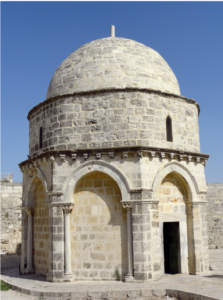
In harmony with this information, tradition situates the Ascension at the top of the central hill of the group called the Mount of Olives, just over a kilometer from the city in the direction of Bethphage and Bethany. In the second half of the fourth century a church was built on this 800-meter-high hill. According to several sources the project was initiated by a noblewoman named Poimenia who had travelled to the Holy Land from Constantinople. The church was known as Imbomon. Egeria relates how the faithful of Jerusalem would gather at this spot for some ceremonies in Holy Week and at Pentecost.


In Jerusalem, two churches commemorate the mystery of the Assumption of the Virgin: the Basilica of the Dormition on Mount Zion, and the Tomb of the Virgin Mary, near Gethsemane.
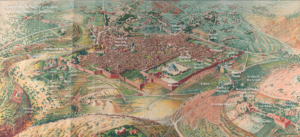
Among the traditions of the Holy City, Jerusalem, are some apocryphal writings generically known as Transitus Virginis (“the passing of the Virgin”) or Dormitio Mariæ (“the falling-asleep of Mary”). The latter title represents the notion that the end of our Lady’s life was like a sweet dream. These writings tell that, when the Virgin Mary left this world, the Apostles gathered around her bed and our Lord himself came down from heaven, amidst myriad angels, and took his Mother’s soul; then the disciples placed her body in a tomb and three days later our Lord returned and took her body to reunite it with her soul in paradise. The authors of such writings speak of two different places: the house where her soul left her body, and the tomb from which her body was assumed into heaven.
We find echoes of these testimonies in the teachings of several of the Fathers of the Church. St. John Damascene, who died in Jerusalem halfway through the eighth century, gives an account of the Assumption of our Lady into heaven that follows the apocryphal writings, and situates the events in the Upper Room and the Garden of Olives. The Virgin’s body, he says, “was prepared for burial and carried out of Mount Zion, set on the glorious shoulders of the Apostles, and borne, together with her casket, to the heavenly temple. But before this it was led through the city like a beautiful bride, adorned with the matchless splendor of the Spirit; and thus it was taken in procession to the holy Garden of Gethsemane,
with angels before it and behind it and covering it with their wings,
together with the whole of the Church.”( St. John Damascene, Homilia II in Dormitionem Beatæ Mariæ Virginis, 12).
In the Holy City of Jerusalem two churches preserve the memory of these mysteries today: the Basilica of the Dormition of Mary on Mount Zion, a few meters from the Church of the Cenacle; and the Basilica of the Tomb of Mary, in Gethsemane, near the olivegrove where Jesus prayed on the night of Holy Thursday.
We know very few details our Lady’s last years on earth. Between the Ascension and Pentecost, Sacred Scripture tells us that she was in the Upper Room or Cenacle.1Afterwards, she would probably have stayed with St. John, to whose filial care she had been entrusted.2Scripture does not tell us when or where her Assumption took place. Some very ancient sources say it was in Jerusalem; others, more recent, in Ephesus.
Chapter 15 on pages 182 to 197 described Mount Zion, the hill on the southwest edge of Jerusalem, which was given the name “Mount Zion” in the Christian era. There, in the Upper Room, the early Church was born; and there, in the second half of the fourth century, a basilica was built which was called Holy Zion and was considered to be the mother of all churches. As well as the Cenacle, the basilica included the place of the “transit of our Lady,” which tradition said took place in a house within the zone. The basilica underwent several destructions and restorations in the following centuries, until only the Cenacle itself remained standing. However, the link between this place and the life of the Blessed Virgin Mary was never forgotten, and in 1910the German Emperor Wilhelm II obtained landon Mount Zion, and a Benedictine abbey was built there, with a basilica next to it dedicated to the Dormition of the Virgin.
The basilica is built in a German Romanesque style with Byzantine features and has two levels. The upper level contains the main church, circular in plan, crowned by a large dome decorated with mosaics. Six side chapels surround it, and on the eastern side there is a vaulted apse for the sanctuary, topped by a half-dome with a prominent mosaic.
The lower level is the crypt, whose central focus is a figure of the Blessed Virgin lying as if asleep beneath a small dome supported by columns. The shrine is encircled by several chapels donated by different countries or associations.


At the same time, “the As sumption is a reality that touches us too, for it points us in a luminous way toward our destiny, that of humanity and of history. In Mary, indeed, we contemplate that reality of glory to which each one of us and the entire Church is called.” (Pope Benedict XVI, Angelus, 15 August 2012.)


It is there that Mount Carmel stands, especially linked to the memory of Elijah and Elisha (Elias and Eliseus), two great Old Testament prophets; and, in the Christian centuries, to the birth of the Carmelite Order.
The history of Mount Carmel is closely linked to the Prophet Elijah or Elias, who lived in the ninth century before Christ. According to traditions referred to by the Holy Fathers and ancient authors, several places preserved the memory of his presence: acave on the northern slope, above Haifa, in which Elijah and afterwards Elisha lived; near that, the place where he gathered his disciples, which Christians named “The School of Prophets,” and in Arabic also El Hader or Hadar; and not far away, towards the west, a spring known as “Elijah’s Spring,” which he is supposed to have brought forth from the rock; and, in the southeast of the range, the peak called El-Muhraka and the Kishon River, where he confront ed the four hundred and fifty prophets of Baal. Through Elijah’ prayer, God sent fire down from Heaven and so the people aban
doned their idolatry, as told in the First Book of Kings (1 Kings 18:19–40.).
Here you can also visit Stella Maris Monastery, the largest Carmelite Monastery and world center of the order.
(1 Kings 18:19–40.).

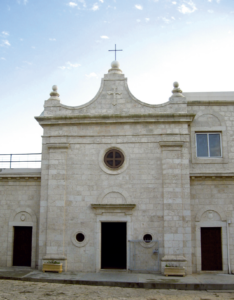
Space does not permit a full account of the history of the Carmelite order here. Regarding what is related to the Holy Land, it is enough to say that, except for a brief period in the seventeenth century, the Carmelites were not able to re-establish themselves on Mount Carmel until the early nineteenth century. Between 1827 and 1836, the current monastery and church of Stella Maris were built on the north point of Mount Carmel, above a cave that commemorates the presence of the prophet Elijah. The name Stella Maris (“Star of the Sea”) recalls that just as the little cloud seen by Elijah’s servant brought the rain that would restore fruitfulness to the land of Israel after the time of the false prophets,4 so too the Blessed Virgin Mary.

The entrance to the church is on the west side; the central space is octagonal in
shape and is covered by a dome decorated with scenes of Elijah and other prophets, the Holy Family, the Evangelists, and some Carmelite saints. The paintings were created in 1928.


The focus of attention is drawn to the sanctuary: behind the altar, in a niche,
stands a statue of Our Lady of Mount Carmel, and below it is the cave in which, according to tradition, Elijah lived. This is a space of roughly three by five meters, separated from the nave of the church by two porphyry pillars and some steps; within it there is an altar and a statue of the prophet.


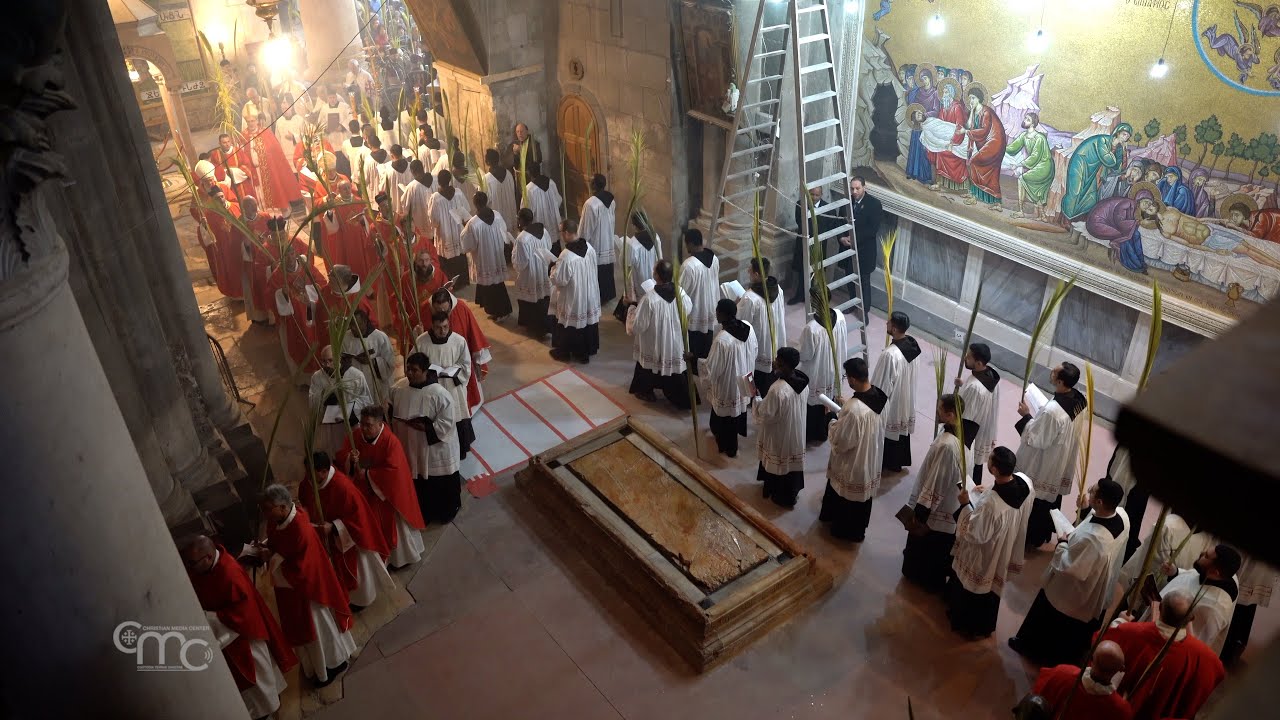
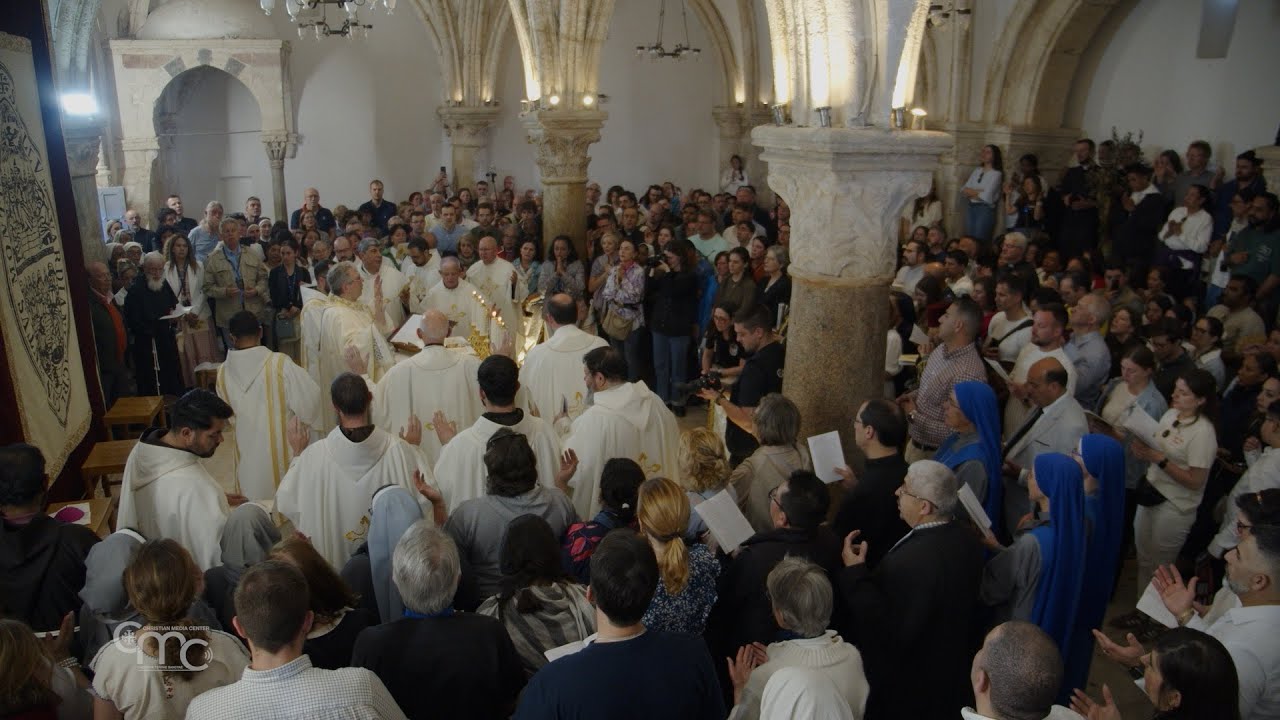


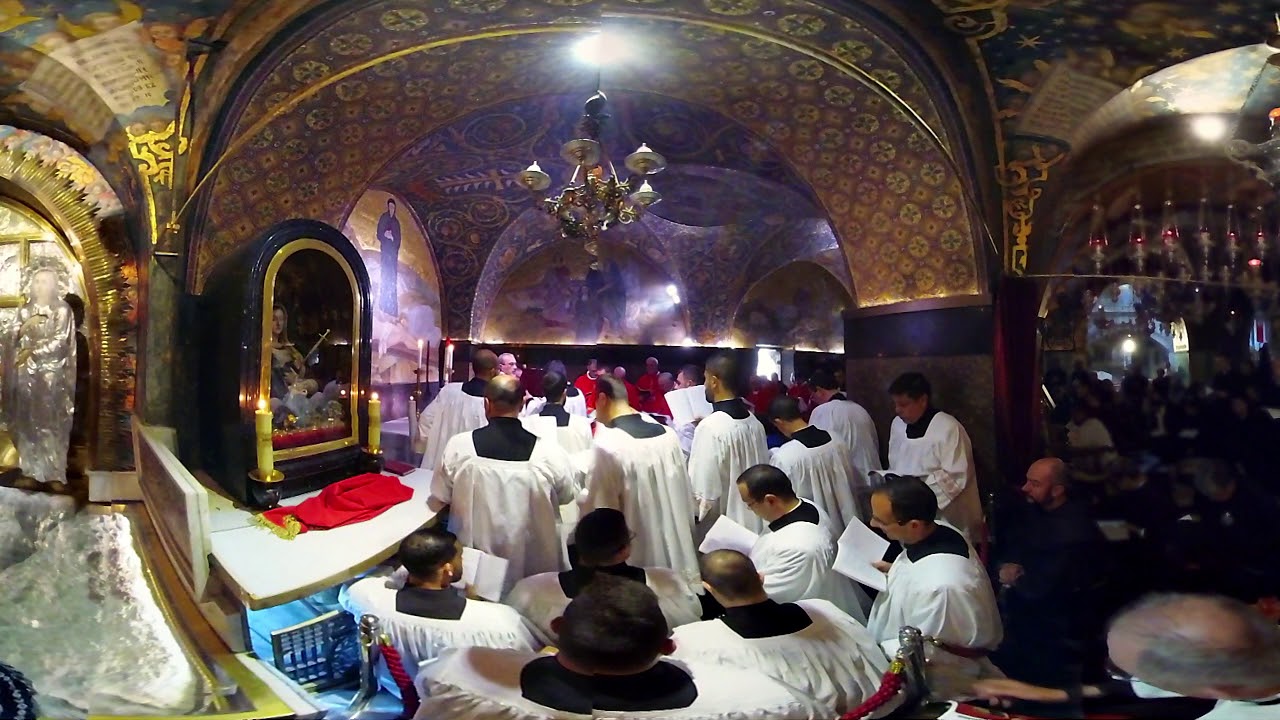




Year: Completed in 1924 Description: This basilica was built on the site of a former Byzantine and Crusader church to commemorate the transfiguration of Jesus. It adopts a Roman-Syrian architectural style, featuring twin towers and an underground…

Basilica of Gethsemani

Inside of the Basilica Dominus Flevit (where Jesus cried)

The Rock where Jesus sweated blood.

Inside of the Basilica of Gethsemani

Gethsemani

Basilica of The Visitation - Eim Karim

Eim Karim

Eim Karem

Eim Karem

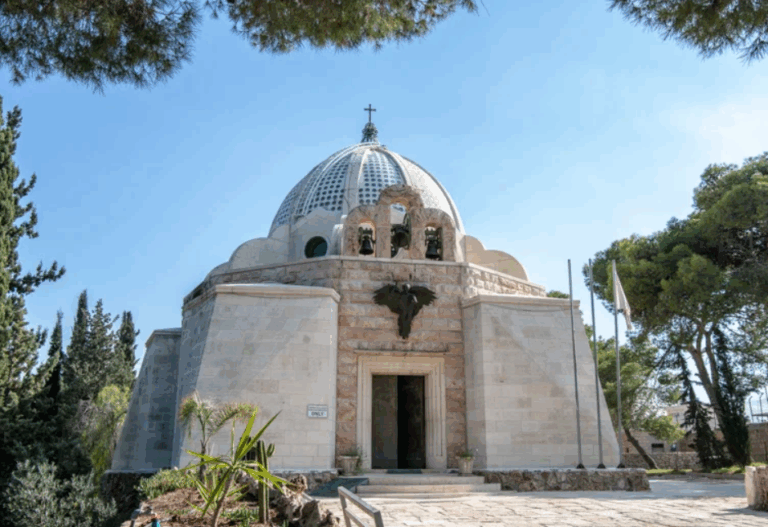
The Cave of the Shepherds - Bethlehem